
Coming to Lisbon for a few days? What to do....


We've had more people visit us in Lisbon, Portugal than any place we've visited since we started full-time travel in 2022. Now that we live here, we've regularly had friends and family drop in for a few days, with more expressing interest. We are delighted to see friends and family. Of course, we like to stay in a place for a while, but we understand that most folks we know are looking for a shorter vacation. Here are our suggestions for what to do in Lisbon if you are only visiting for a short time.
If you are visiting for up to 3 days
See a fado show
Fado, a musical genre unique to Portugal (and Portuguese-speaking countries), is a must. Trained singers and instrumentalists keep this long tradition alive. Fado music is documented as early as the 1820's, originating in Lisbon, but is thought to have begun in bars and cafes much earlier. There are many good shows in Lisbon. I'd recommend going to one in the Alfama neighborhood, such as Clube de Fado (where you can make reservations online) or Parreirinha de Alfama (which is across the street from the Fado Museum). We recently saw a show at Senhor Vinho, a great choice across the city. We've also seen shows in the Biarro Alto neighborhood. Typically a fado show will offer dinner at a set price, or a la carte (check the website for this information), and charge an additional amount for drinks. The music is included in the price. Guests are expected to be completely quiet during performances, and food service will be suspended during that time (but you can eat quietly). Typically performers will sing a set of three songs. Then there will be a break, followed by additional sets. Usually these are solo vocalists, but occasionally a group will sing a song (usually at the end of the night) or a vocalist will invite the audience to sing along a well-known song. If you only have time for one thing, see a fado show. Note that Portuguese people eat later than most Americans so the earliest time I have found for a fado dinner reservation is 7pm and the show probably won't start until at least 8.

Walk through Alfama, stopping to see the Cathedral, the Castle, and the views
Lisbon started in the geographic area now known as the Alfama neighborhood more than 1,600 years ago. Settled initially by pre-Celtic tribes, then Phoenicians, then Romans (who named it Olisipo). It was ruled by the Moors in the 8th century, and taken by the Christian Crusaders in 1147. It was the Moors who gave it the name Alfama, and that name stuck for the neighborhood which was soon surrounded by a castle wall, still standing today.
You can ascend into Alfama several ways from the center city, but we like to go to Martim Moniz square (which is named after the crusader Martim Moniz, who martyred himself by wedging his body between the castle doors during the invasion of the Moors). The square has a Metro stop. From there, you can climb up the stairs.

You can also take a free elevator from Baixa, which you can find here. Once up top, you can wind your way along the streets up to the Castelo de Sao Jorge, which has stellar views of the city (one of the classic miradouros, or "golden views." You can walk the castle walls, see remnants of some rooms, see many peacocks, and take a tour of a Moorish settlement. You might want to stop along the way at some artisan shops, such as By Nunes, a family-owned original tile shop just around the corner from the castle entrance, or look for small artisanal collective shops with crafted jewelry and other items on the way up. You could avoid the numerous souvenir shops offering uninspired tiles, scarves, and knick-knacks, likely imported from outside of Portugal. There are lots of authentic spots if you pay attention.
As you climb, find the time to visit the Cathedral (Sé de Lisboa), built in 1147 in a Romanesque style, but later additions include features that are Gothic, Baroque, neoclassical, and Rococo. You can go upstairs and see views of the city and the river from a balcony.
In addition to the viewpoints at the castle, there are wonderful views from the Miradouro da Graça:
...and the Miradouro de Santa Luzia:
On the way down, you might want see the old Roman theater archeology dig, which is here; there is a museum across the street but we have not been inside.
You can also stop and eat at one of several restaurants that feature views of the city overlooking Commercial Square and the Tagus River. We had an anniversary dinner at Chapitô à Mesa, which had good food, great service, & a terrific view. But we've also just stopped at other restaurants nearby. If you time it right, you can see the sun set over the river and walk down to the lights of the bridge and Commercial Square.
Eat seafood, drink sangria, & eat at least one pastel de nata
While you are in Lisbon, you should eat seafood and drink sangria (and other Portuguese wines). The seafood in Lisbon is fresh and delicious. Sardines are a specialty of the region, especially in June and July. Sangria is a mix of wine (could be red or white), plus liqueurs, juice, fresh fruit and mint. I've never had sangria made the same way twice. It is especially delicious on a hot summer day. The other regional specialty is bacalhau (Atlantic cod fish), and the iconic preparation is Bacalhau à Brás. You will see the dried, salted codfish in all the local grocery stores and delis. Portuguese soak the fish for days to eliminate the salt. You can get seafood and sangria at almost every restaurant. Also try other local Portuguese wines. They are delicious and inexpensive for the quality. Finally, eat at least one pastel de nata - the national pastry. Rich, creamy, and sweet, you'll see why Portuguese people love it!
Visit Chiado
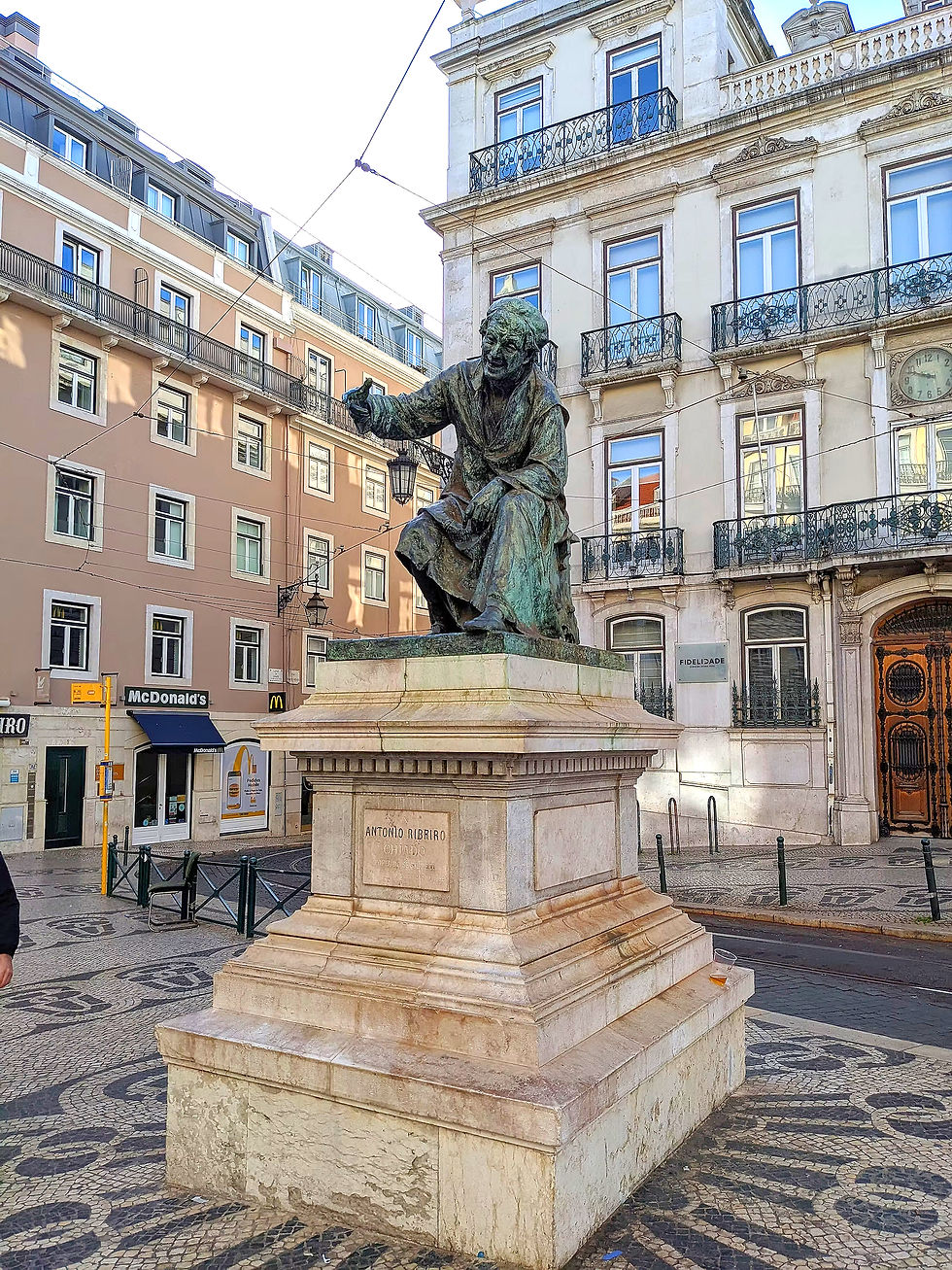
When we lived in Lisbon for two months in 2022, we stayed in the Chiado area of the Bairro Alto, near Praça Luis de Camões. We find this area charming because it pays homage to Lisbon's poets, writers, and philosophers. It also offers an entrypoint to one of the best golden views in the city. When we have taken visitors to Chiado, we often start in Praça Dom Pedtro IV, near the Rossio Metro Station.

The square itself is in Baixa (meaning "low place"), so you have to climb a gentle slope up to Chiado. In the square, notice the tile pattern, giving the illusion of a 3-D pattern. If you look up, you will see the Santa Justa Elevator, built in 1901. It connects the Baixa area to Bairro Alto near the archeological ruins of a convent that was destroyed in the 1755 earthquake; the convent dates back to 1389. If you go up at night, the view is stunning.
But we go up by walking behind the elevator, and taking the gentle slope up and to the right on Rua Garrett. At the top, you will see a statue of the poet António Ribeiro (1520-1591), nick-named "Chiado." Just before you get to the statue, you will pass the oldest continuously operating bookstore in the world, Bertrand Bookstore, opened in 1747, which has a vast selection of books in many languages. Also near the statue, you might want to get a bica (espresso) at Café A Brasileira, a popular spot for poets & philosophers in the 1920's. There you will find a statue of another famous Portuguese poet, Fernando Pessoa (1888-1935). Take your picture discussing philosophy with him!

If you continue up the street, you will land in Praça Luis de Camões, named after Portugal's most famous poet, who lived in the time of Vasco de Gama, and who wrote an epic poem about Portugal, Os Lusíadas, published in 1572. We like to turn right in front of Camões Square, and walk up the Rua da Misericórdia, stopping at D'Orey Tiles. Here, you can browse antique tiles recovered from around Portugal (and some from Spain). We love these authentic tiles. While many are quite expensive, some are more affordable. All are delightful to look at. They also offer tile-making workshops.
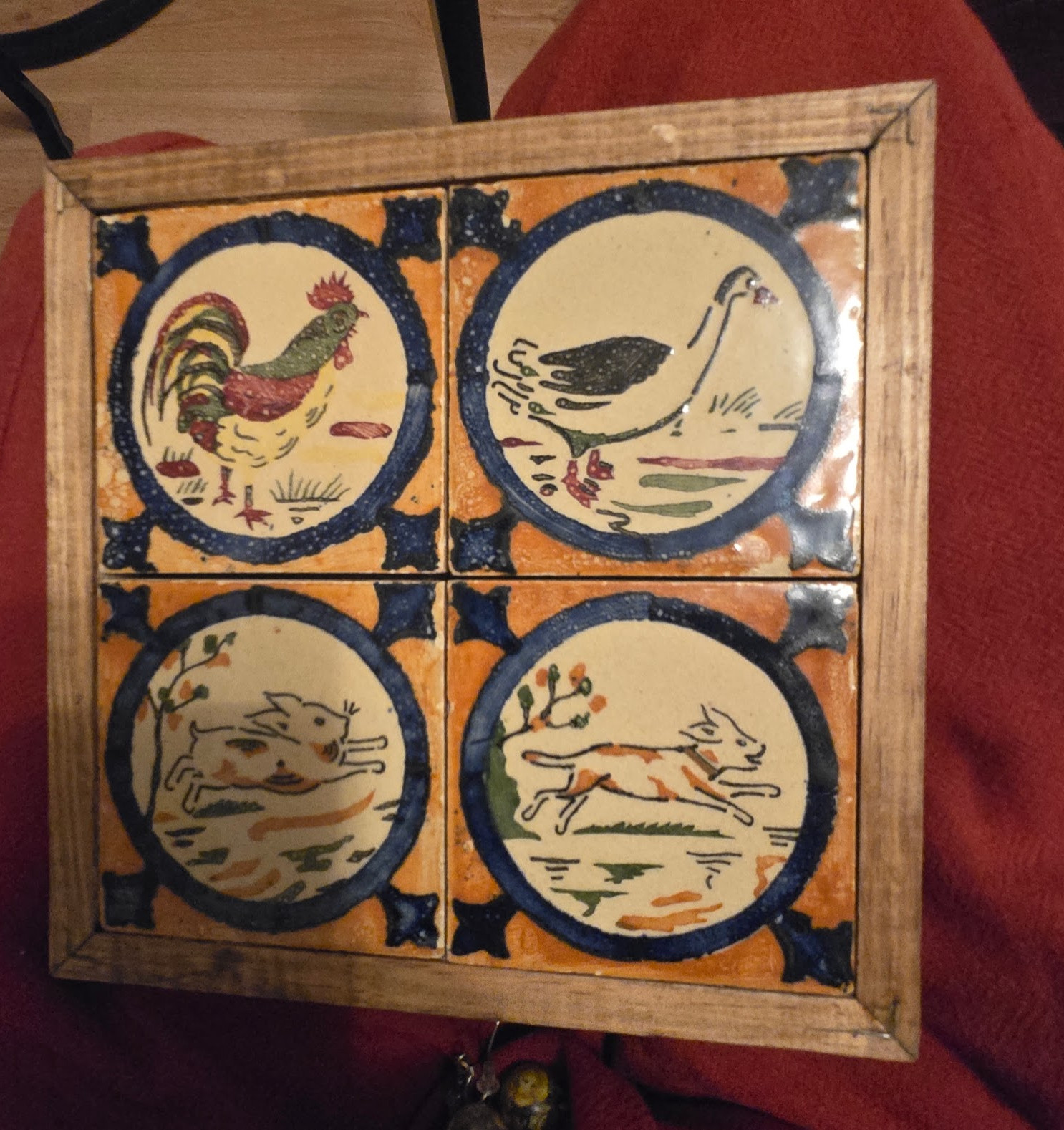
A little farther up the street is O Mundo do Livro, which sells used books, reproduction prints, paintings, and maps.
We bought this reproduction print of the Tower of Belém, and had it framed there.

Continue up the Rua da Misericórdia. You will pass a largo with some beautiful churches. Just past the largo, you will arrive at the Miradouro de São Pedro de Alcântara, one of the most beautiful views in Lisbon. You can see the river, the castle across the way, the Rossio train station, and the trees of the Av. da Liberdade.
If you continue up the hill, you will be in Principe Real, an upscale area with a nice farmer's market on Saturdays. But usually we walk back to Camões Square. Taking the Rua das Flores (a very steep downhill), you can have a lovely meal at Taberna da Rua das Flores You can't make a reservation, but if you eat early like we Americans do, you should be able to get a table without a long wait. It is a tapas-style restaurant with daily offerings and the food is Portuguese chef-made and delicious. You can then walk down the street to Cais do Sodre station, and walk along the waterfront to Praça do Comércio.
There are many restaurants in this area. The blue line Metro stop, Terreiro do Paço is at this location, or you can walk along Baixa back towards Praça Dom Pedro IV, where we started, and take the Green line at Baixa-Chiado or at Rossio.
Walk through some of the less touristed neighborhoods, & visit the parks, cafes, and restaurants
If you're in Lisbon for a few days, I would urge you to find one of the less touristed neighborhoods and spend an afternoon or evening just walking. If you pass an Auchan, Continente, and Pingo Doce (3 grocery chains); at least 5 cafes; and at least 3 fruiteria in a 5-block area, you know you are in a place where people live. There are lots of choices - you can't go wrong. Here are some of them, but clearly you will have to pick just one if you're only here a few days.
Maybe go to the Arroios Metro stop, and have a bifana at the small shop on the circle, A Parreirinha do Chile. A bifana was described to us as "Portuguese fast-food" - it is pork (not beef) cooked in a lovely juice, put in a round, fresh bread called a "papo seco", and often topped with cheese, mustard, and hot sauce. Some people say this small shop has the best bifana in Lisbon. A short walk takes you to Kingpin books, where you can browse a wonderful collection of graphic books in Portuguese.

Or, go to the Saldanha Metro stop, and eat at Colina. Walk the streets to the Instituto Superior Técnico, then get on the Alameda Metro stop by its huge green spaces. Go to Areeiro Metro Stop and take a walk through Fernando Pessa park, or to Campo Grande Metro stop for a walk through Jardim do Campo Grande. Or, go to the Metro at Campo Pequeno and see the old bullring, which is now an arena, mall, and food court.
Or, go to Pombal Square and walk up the length of Parque Eduardo VII. Take in the statues, the trees, and the buildings on the sides. If you're there in late May, see the jacaranda trees blooming. If you're there in June, go to the book fair. Go to the miradouro at the top of the park. While you are there, go inside the Parque Metro station and admire the amazing tiles depicting the world during the time of Vasco da Gama.
Or, go to the São Sebastião Metro stop and visit the Calouste Gulbenkian park and contemporary art museum. This lovely green space has lakes, sculpture, an ampitheater, and a cafe. From there, it is a short walk to the large department store, El Corte Ingles, with lots of restaurants.

Another good choice would be to visit the Anjos neighborhood, accessible from the Anjos Metro stop. There, have a great cup of coffee at Coffee in Brew, visit the surrealist tile shop, Surrealejos, and see the view from the Miradouro do Monte Agudo.
A slightly different vibe is found at the Parque das Nações (Park of Nations). Formerly an industrial area on the farthest inland area of the Tejo estuary, the space was transformed for the World Expo in 1998. It is now a beautiful park with biking and walking trails, statues, plants and many restaurants. There, you can see the Vasco da Gama bridge which traverses the estuary, ride in a skylift, & shop at the Centro Vasco da Gama. It is easy to get here by going to the Oriente metro stop.
We are less familiar with some of the other neighborhoods - Santos, São Bento, Estrela - but each neighborhood has its charms. Just pick one, and walk. Stop for a coffee. Browse the stores. Look for the vistas. Notice the patterns on the sidewalks and the squares, & notice the tiles on the building facades. They are all over the city. See how folks live in Lisbon.
Visit Belém
If you have 3 days, it is worth using one of them to visit Belém. Only about 30 minutes from Cais do Sodre on the above-ground metro line (or a quicker Uber ride), you really get a feel for Lisbon's age of discovery with a beautiful river walk.
While there, visit the original maker of the iconic pastel de nata, but here called a pastel de Belém. You can walk to Pastéis de Belém from the tram stop, about an 8-minute walk. There are multiple entrances so look for the one with the shorter line. The cafeteria is huge, so you can find a seat and order your pastries and coffee.
From the bakery, it is a short walk to the Jerónimos Monastery. The structure dates to 1469, with construction ongoing for many years. The area was a safe place for seafarers, and the carvings inside are a testament to the travels of Portuguese sailors. Both Vasco da Gama and the poet Luis de Camões are buried in the church, and you can walk by their tombs. Other notable figures are buried in the monastery, including Fernando Pessoa. The monastery is a stunning architectural wonder and well worth the price of a tour ticket. Entering the church is free.
Across from the monastery are some beautiful parks, and across from the parks is the waterfront. On the waterfront, you can see the the Monument of the Discoveries and the Belém Tower. There are several museums in Belém as well - we have not been to them but we hear they are very interesting. The MAAT Museum (Museum of Art, Architecture & Technology) is also on the way back from Belém towards Lisbon and is worth a visit.
Go to the Tile Museum (Museu Nacional do Azulejo)
If you get a chance, visit the Tile Museum. It's been closed for renovations since we returned earlier this year, but we went there is 2022. It is amazing.
If you have additional days
There are some places that make for a great day trip from Lisbon if you are here additional days. The ones I'm mentioning here are each an hour or less by public transit from Lisbon.
Visit Sintra
Sintra, home to the Renaissance style Pena Palace, the medieval Castle of the Moors, and a UNESCO heritage town with lovely streets, restaurants, and shops is easy to get to and well worth the visit. When we went in 2022, we took a train from Rossio Station in Lisbon, then took an Uber to the Pena Palace, which is on a hill. After touring the Pena Palace, we walked down the hill into the town. We've also been advised that we should visit the Palácio Nacional de Queluz, which is about half-way between Lisbon & Sintra, but we haven't gotten there yet. We went in mid-February, 2022, and although there were plenty of people, it was not uncomfortably crowded. I hear in peak seasons you can barely walk through the palace, so plan accordingly.
Visit Obidos
We visited Obidos in August of this year with our son. Home to a medieval castle built in the 12th-14th centuries, the area has been inhabited since the late Paleolithic era, which ended around 10,000 B.C.E. It was inhabited by Celts, Romans, Phoneicians, Moors, and others. The area was secured by the first king of Portugal, Alfonso Henriques in 1148. The town was a gift to a succession of Portuguese queens, and was also a site of resistance during the 1974 Carnation Revolution.
Today is is a charming and historic UNESCO heritage site. We ate in cafes, walked along the medieval wall and inside the castle grounds, shopped in small establishments and visited two beautiful churches. It was a lovely day. Obidos has several festivals of note: a chocolate festival in March, a medieval festival in July, a book festival in October and a Christmas village & market in late November-early January of each year.
Visit Cascais
About an hour from Cais do Sodre by tram, Cascais is the spot where the Tejo River meets the Atlantic Ocean. This town is known for beautiful beaches, amazing seafood, and charming streets. You can see a lighthouse, stop at cafes along the beach, and soak up the history. It's also one of the luxury spots in Portugal. We haven't been this time around, yet, but here are some photos from a day trip there in 2022.
You can see that you won't have any trouble finding things to do in and around Lisbon. I didn't even get to most of the museums, some of the parks, the aqueduct, the Roman ruins under a bank building - well, you get the picture. So come to Lisbon. And when you get here, drop us a line!


Comments